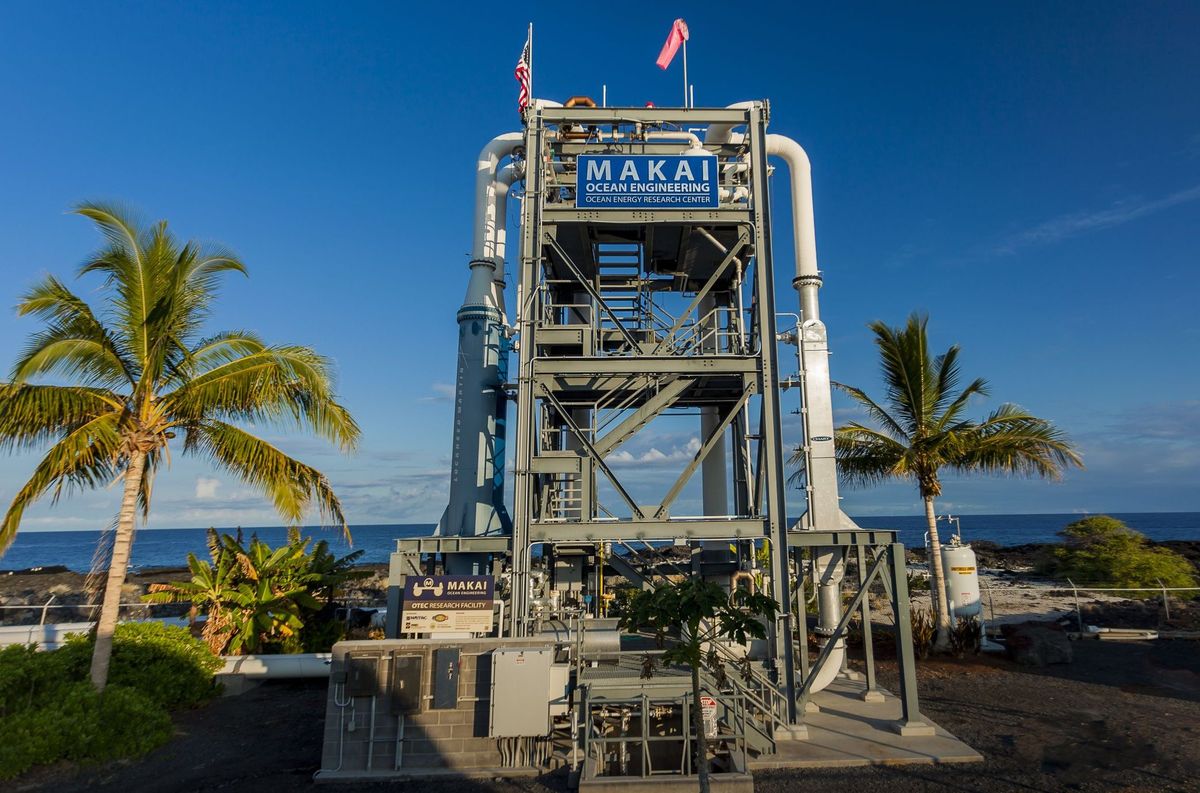
What is OTEC?
Ocean Thermal Energy Conversion (OTEC) is a renewable energy technology that harnesses the temperature difference between warm surface water and cold deep seawater to generate electricity.
Using a low-boiling-point working fluid, the system produces steam from the heat of surface water to drive a turbine, which is then condensed by deep cold water. For efficient operation, the temperature gradient must be at least 20C.
3 Types of OTEC
Open Cycle: Uses warm surface seawater directly; placed in a low-pressure chamber, it boils into vapor to spin a turbine and produce electricity, the vapor is also desalinated freshwater.
Closed Cycle: Employs a low-boiling-point fluid like ammonia. Warm seawater vaporizes the fluid, which drives the turbine, while cold deep seawater condenses it back into liquid for reuse.
Hybrid Cycle: Combines both open and closed cycles, warm seawater is vaporized in a vacuum chamber, and its vapor heats the working fluid in a closed system to generate electricity more efficiently.
OTEC Opportunities and Challenges
Ocean Thermal Energy Conversion (OTEC) has great potential to address rising global energy demand, especially in tropical regions with stable ocean temperatures year-round. By using the temperature difference between surface and deep seawater, OTEC can generate renewable energy continuously.
However, its low thermal efficiency often below 4.97% due to a small temperature gap of around 20C, remains a key challenge. To improve performance, integrating OTEC with other heat sources like solar or industrial waste heat is essential.
Moreover, to enhance its economic viability, OTEC should be developed as a multi-purpose system for electricity generation, desalination, cooling, aquaculture, and hydrogen production. This integrated approach can boost its value and support global efforts toward sustainability and carbon reduction.
Indonesia's OTEC Hotspots Where Ocean Power Thrives
There are seven locations in Indonesia that have great potential for Ocean Thermal Energy Conversion (OTEC) implementation, namely:
1. North Sulawesi
2. South Sulawesi
3. West Papua
4. South Kalimantan
5. East Kalimantan (Makassar Strait)
6. East Strait
7. Morotai Island (Morotai Sea)
These seven areas have a high temperature difference between the sea surface and a depth of 500 meters, which is more than 20C, an ideal condition for operating OTEC systems efficiently.
From the comparison of the seven locations, North Sulawesi and South Kalimantan have the best temperature potential in planning the implementation of OTEC with a temperature difference between sea surface and deep sea water (500-600 meters) of 28.5C to 30C.
From this information, OTEC technology is considered suitable for implementation as a strategic step to sustainably utilize tropical ocean energy in Indonesia.
References
Chen, W., & Huo, E. (2023). Opportunities and challenges of ocean thermal energy conversion technology. Frontiers in Energy Research, 11. https://doi.org/10.3389/fenrg.2023.1207062
Fadllillah, A. A. Z., Sanjaya, K. V. K., Arkananta, M. Z., & Darmawan, W. (2023). Potensi Panas Laut sebagai Energi Baru Terbarukan di Perairan Kepulauan Nusa Tenggara Timur dengan Metode Ocean Thermal Energy Conversion(OTEC). JEBT: Jurnal Energi Baru & Terbarukan, 5(1), 71-84. https://doi.org/10.14710/jebt.2024.22080
Irfan Faizin, B., Mahardika Sinulingga, M., & Rayhan Harashta Teknik Kelautan, M. (2023). ANALISIS POTENSI PENERAPAN OTEC UNTUK MENCAPAI TARGET ENERGI BARU DAN TERBARUKAN NASIONAL DI PESISIR KEK MANDALIKA (LOMBOK, NTB). Figshare. https://doi.org/10.6084/m9.figshare.22331185
Sakthivel, C., Pradeep, R., Rajaskaran, R., Bharath, S., & Manikandan, S. (2018). A review of ocean thermal energy conversion. GRD Journals. 275-280.
Syamsuddin, M. L., Attamimi, A., Nugraha, A. P., Gibran, S., Afifah, A. Q., & Oriana, N. (2015). OTEC potential in the Indonesian seas. Energy Procedia, 65, 215222. https://doi.org/10.1016/j.egypro.2015.01.028